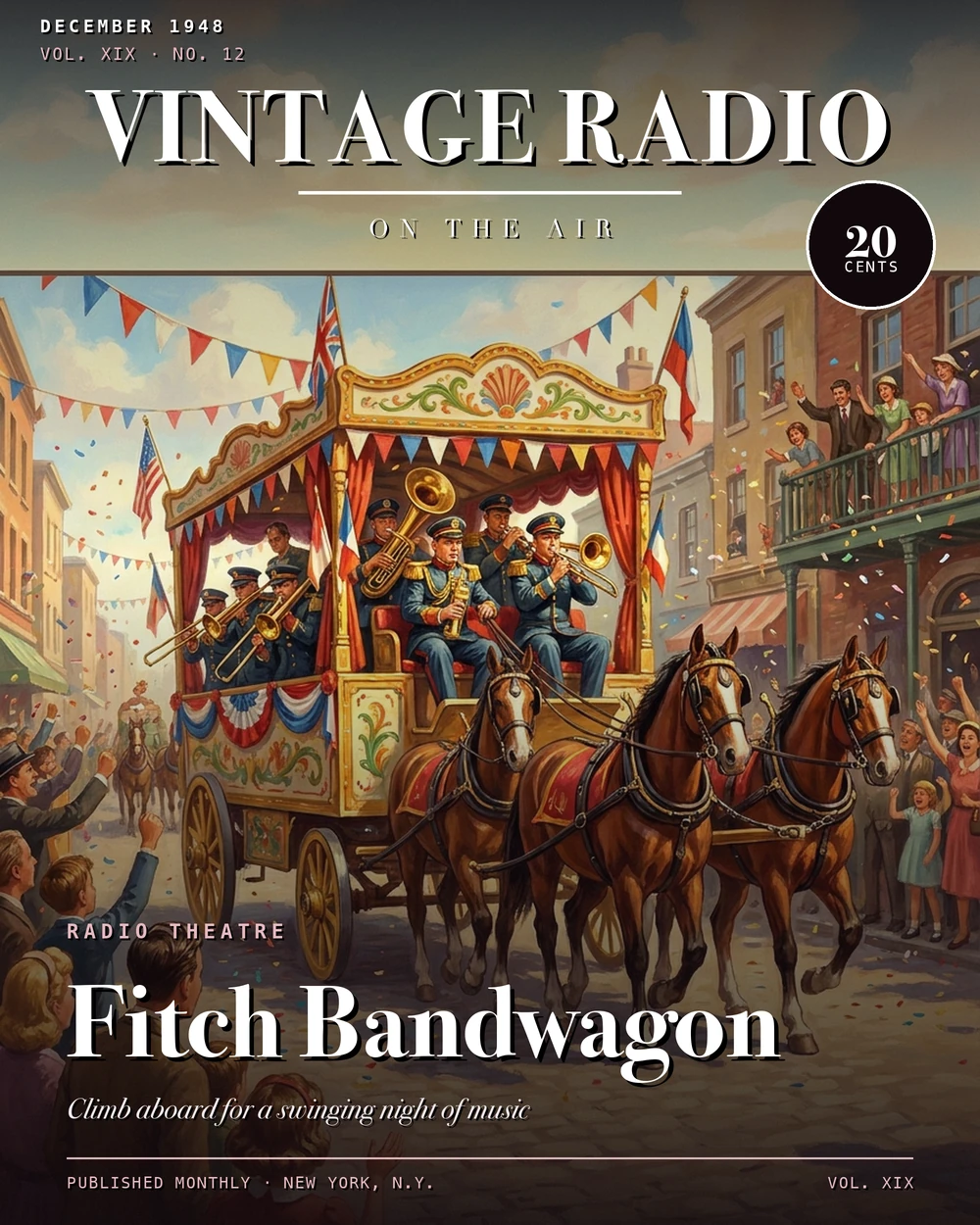
Fitch Bandwagon
A Shampoo Company That Built a Radio Institution
The Fitch Bandwagon's origins say something about how radio advertising worked in the early 1930s. Frederick Walter Fitch had spent decades selling hair tonics and medicated shampoos exclusively to barbershops, but in 1932 he decided to go after the general consumer market through drugstores. To reach that new audience, he bought airtime. Starting that same year, a weekly 15-minute program of live music went out over WOC in Davenport and WHO in Des Moines, aimed mainly at Iowa listeners. Fitch had been born in Burnside, Iowa, and his company's four-story plant stood at 15th and Walnut Streets in Des Moines, so it was a natural place to start.
The show moved to the NBC network in the fall of 1933, when the network numbered only twenty-three stations. That made Fitch the first Iowa manufacturer to sponsor a national radio program — a distinction the company clearly took seriously, because it stayed with radio for the next fifteen years without switching sponsors once. The NBC run that most listeners remember began September 4, 1938, when the program expanded to a full half-hour and locked into Sundays at 7:30 p.m., a slot it would hold through every format change until the final broadcast on May 23, 1948.
The F.W. Fitch Company that bankrolled all of this had grown well beyond Iowa by mid-century. Plants operated in Des Moines, Los Angeles, Bayonne, Jackson, and Toronto, and the company manufactured more than forty products. Its origins were humbler: Fitch's first item was labeled "Ideal Hair Grower and Dandruff Cure," developed with the input of a physician named Dr. Brechbill. The F.W. Fitch Company Historic District at the Des Moines plant address was eventually listed on the National Register of Historic Places in 2013.
The Big-Band Years
From its 1938 half-hour premiere through June 1945, the Fitch Bandwagon was straightforwardly a big-band showcase. The roster reads like a who's-who of the swing era: Freddy Martin, Jan Savitt, Harry James, Tommy Dorsey, Harry Sosnik, Jimmy Grier, Guy Lombardo, Cab Calloway, and Ozzie Nelson all appeared. One of the production's more distinctive logistical choices was that each broadcast originated from whatever city the guest band happened to be playing at the time, sending the show to New York, Chicago, Los Angeles, and beyond. At the end of each episode, the program offered a musical biography of that week's featured bandleader — a small but consistent touch that gave the show a character slightly beyond pure entertainment.
The show ran through a succession of Masters of Ceremony. Henry M. Neely, known in radio circles as "the old stager" after years as a CBS commentator, resigned his CBS position to take the Fitch job and held it from the third broadcast in September 1938 through June 1940. Tobe Reed followed from around 1940 to 1943, and Tom Reddy — formerly of WHO radio in Des Moines, which connected him to Fitch's Iowa roots — took over through September 1944. Dick Powell came aboard in September 1944 and shifted how the M.C. role worked: where earlier hosts mainly introduced the bands, Powell performed songs and participated in comedy skits, pointing the direction the show would soon travel. His guests during that tenure included Eddie Cantor and Andy Devine.
By 1942 the show occupied a prime-time slot on the NBC Red network and was carried on more than 120 stations nationwide. Radio historian Jim Ramsburg noted that while "Bandwagon lost over half of Benny's audience, never rising above the mid-teens in ratings, yet was solid enough to finish in the season's Top 50 for eight consecutive years." That placement was partly a function of scheduling: the show sat between The Jack Benny Program at 7 p.m. and The Chase and Sanborn Hour with Edgar Bergen and Charlie McCarthy at 8 p.m. As Buxton and Owen wrote in The Big Broadcast 1920–1950, many people assumed the show was simply "lucky to be sandwiched" between two powerhouses — but the same historians argued the Bandwagon "pioneered Sunday evening entertainment programming, because prior to its appearance most broadcasters felt that Sunday programming should be of a more religious or serious nature."
During the summer months from 1939 through 1942, the show ran a "Summer Bandwagon" series featuring up-and-coming bands not yet nationally famous. The 1939 series ran fourteen weeks and included Jack Teagarden, Van Alexander, Johnny Long, and Mitchell Ayers, with Garry Morfit as M.C. The 1944 summer run featured Les Brown and his orchestra every week, with a young Doris Day among the vocalists. These summer editions kept the show in its timeslot year-round and gave lesser-known acts a national platform.
The Circus Broadcasts
One recurring feature of the big-band era deserves its own mention: the annual Ringling Bros. and Barnum & Bailey Circus broadcasts. F. Beverly Kelley, director of radio publicity for the circus, first approached the Fitch Bandwagon producers in 1939, but it took two full years of persistence to convince Fitch's advertising agency to devote an entire broadcast to circus music. When the Ringling band finally appeared in 1941, it generated the heaviest telephone and fan-mail response the program had ever received.
The annual circus broadcasts continued every year through 1948, always live from Madison Square Garden to coincide with the Ringling circus's New York opening stand. The Fitch Company invited a large audience of children to attend each broadcast; during World War II, many of those invited guests were children of service personnel stationed overseas. A 1943 circus broadcast, hosted by Tobe Reed with announcer Ben Grauer handling the Fitch commercials, featured Merle Evans as musical director along with Kelley himself, equestrian director Fred Bradna, and F.W. Fitch in person. The scripts for these broadcasts were co-written by Kelley and the show's early producer Ward Byron.
Cass Daley Takes Over
From September 1945 through June 1946, the Fitch Bandwagon handed its center to comedian Cass Daley. Born Catherine Dailey in Philadelphia in 1915, Daley had come up through vaudeville, the Ziegfeld Follies, and Paramount films, and had built a radio following through guest appearances on The Kraft Music Hall. Her comedy style ran to raucous sight gags, physical exuberance, and grotesque facial expressions — a style that translated to audio better than it might sound, because much of the humor came from her vocal delivery.
The format threaded Daley's comedy skits through band performances. Each week, announcer Larry Keating set up Daley's situation — say, working as a salesgirl in a music shop — and then handed off to a live band performance before the comedy resumed. Francis "Dink" Trout played a wimpy character named Horace alongside her. Name bands including Glen Gray and his Casa Loma Orchestra continued to appear, performing live within the sketch framework. Starting in January 1946, even those band segments were phased out in favor of other guests incorporated directly into the comedy. The show was visibly in transition — still a Music program by sponsorship and tradition, but pushing hard toward the format it would settle into next.
Phil Harris, Alice Faye, and the Show That Became Itself
The Fitch Bandwagon's third and final phase, which ran from September 29, 1946 to May 23, 1948, was a situation comedy built around Phil Harris and Alice Faye playing themselves. Sponsor F.W. Fitch had been watching the success of domestic-comedy radio, and after a well-received audition on July 10, 1946, the couple earned the Sunday night berth. The format appealed to Faye in particular — it required only a script read-through and a live broadcast each week, letting her stay home with her daughters most of the time, which mattered to her after a bruising exit from film work. Darryl F. Zanuck had ordered twelve of her scenes cut from Otto Preminger's Fallen Angel (1945) to showcase his new protégée Linda Darnell. When Faye saw the final cut, she wrote Zanuck a scathing note and drove off the Fox lot for good. Occasional jabs at that rift found their way into the show's running gags.
Harris had been a figure on NBC for years already, having joined The Jack Benny Program in October 1936 as musical director. His on-air persona — a vain, language-challenged Southern bandleader with a fondness for good times — had made him a comedy draw in his own right on Benny's show, and the Fitch Bandwagon format gave that persona a domestic setting. The premise had Phil bidding Benny farewell at the end of the 7 p.m. show and heading home, providing a seamless narrative bridge for the Sunday-night audience. Harris and Faye had married on May 12, 1941, in Tijuana, and their actual children — Alice Jr. and Phyllis — were folded into the show's domestic fiction alongside adopted son Phil Jr.
The supporting cast filled out the household world. Elliott Lewis played Frankie Remley, a fictionalized version of a real musician from the Benny band who had long been the butt of drinking jokes on that show. Walter Tetley played Julius Abbruzio, a sarcastic delivery boy whose running line was "Are you in trouble, Mistuh Harris? Is there anything I can do to get you in deepuh?" Robert North played Alice's brother Willie, and Jeanine Roose and Anne Whitfield played the Harris daughters Little Alice and Phyllis. Bill Forman announced, Walter Scharf handled the music, and Paul Phillips directed. The character writing sharpened considerably when writers Ray Singer and Dick Chevillat joined in the 1947–48 season, taking over from Joe Connelly and Bob Mosher and evolving Remley from a dim hoodlum into a sardonic wiseman and reliable troublemaker. Singer later told radio historian Gerald Nachman that he and Chevillat considered working for Harris "a writer's paradise" because Harris gave them complete autonomy and never previewed scripts.
Notable guests in the third phase included Jack Benny, Mel Blanc, Gale Gordon, Frank Nelson, Verna Felton, and J. Scott Smart. In one episode, Robert Taylor filled in for Phil Harris and sang Harris's signature song, "That's What I Like About the South." Surviving episode titles trace the domestic premise across two seasons: "Alice Hires a Tutor," "Phil Harris, Homemaker," "The Easter Bunny Suit," "Phil is Put on a Budget," "Selling the House," the "Annual Christmas Show" of December 1947, and the series finale "Planning a Trip to London" on May 23, 1948.
How It Ended and What Came Next
The Fitch Company's finances told part of the story of the show's end. During World War II, military contracts for hair-care products had been a significant revenue source. When those contracts were cancelled after the war, cash flow tightened at the same time that weekly radio production costs were climbing. By 1948, Fitch relinquished its sponsorship to Rexall Drugs, and the show relaunched on October 3, 1948 as The Phil Harris-Alice Faye Show. Harris and Faye chose to stay on NBC rather than follow Jack Benny to CBS during the talent raids of the late 1940s, and NBC offered them a deal to stay. The renamed show ran until 1954.
F.W. Fitch himself sold his company to Grove Laboratories in St. Louis in 1949 for a reported $2 million, and died two years later at his home in Des Moines. The theme song that had accompanied every format of the Bandwagon — lyrics set to the melody "Smile for Me," with lines like "Laugh a-while, Let a song be your style, Use Fitch Sham-poo!" and "Don't despair, Use your head, save your hair, Use Fitch Sham-poo!" — went with it. The show it had promoted had started as fifteen minutes of live music for Iowa listeners and ended as a full-blown domestic sitcom that directly spawned one of NBC's more durable comedy series. That's an unusual arc for any radio program, and the Fitch Bandwagon navigated it without ever changing its Sunday-night timeslot.